
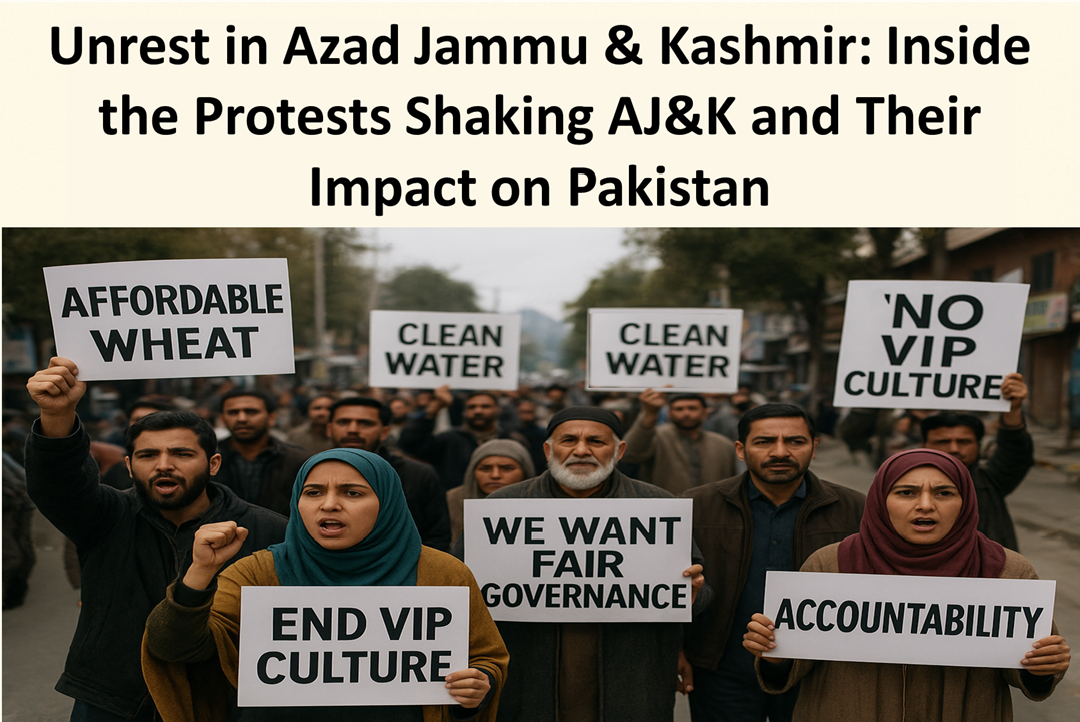
Azad Jammu & Kashmir (AJ&K), long celebrated for its breathtaking landscapes, has become the center of escalating political unrest. Recent protests across Muzaffarabad, Neelum Valley and Mirpur reveal a struggle far deeper than scenic beauty — it’s about rights, governance and accountability. For Pakistan, the implications are both urgent and far-reaching.
The Spark Behind the Protests
In September 2025, widespread demonstrations erupted in AJ&K. Unlike typical political rallies in Pakistan, these protests were not about party politics or leadership rivalries. Instead, citizens demanded affordable wheat, reliable electricity, clean water and fair governance.
At the heart of this movement is the Awami Action Committee (AAC), a grassroots group calling for structural reforms through a detailed 38-point agenda (IndiaToday).
The 38-Point Charter of Demands
The AAC’s demands highlight deep frustration with political and economic mismanagement:
- End VIP Culture: Cut excessive privileges for ministers and redirect funds to public welfare.
- Transparency & Accountability: Launch corruption inquiries against political elites.
- Economic Justice: Subsidize wheat and electricity, enforce minimum wages and revise taxation.
- Women’s empowerment and stronger representation.
- Infrastructure Reforms: Repair roads, ensure fair water distribution and compensate dam-affected families.
- Political Reforms: Abolish the 12 reserved assembly seats for refugees, which AAC claims distort democratic representation.
These points go beyond temporary relief. They strike at the very foundation of governance in AJ&K.
Deadlock: Why Negotiations Failed
The government attempted dialogue by sending federal ministers to Muzaffarabad. After 13 hours of talks, the parties failed to reach agreement on two key issues (DAWN):
- Ending VIP privileges.
- Abolishing refugee assembly seats.
This deadlock intensified protests, forcing the government to deploy thousands of security personnel, further eroding public trust.
Clashes at Neelum Bridge
The protests turned deadly at Neelum Bridge, where rival groups clashed. Conflicting reports accuse both sides of firing shots, but one protester, Muhammad Sudheer, was killed.
Internet blackouts prevented independent verification, further fueling anger and distrust.
The Economic Fallout: Tourism in Decline
The recurring protests since 2023 have devastated AJ&K’s economy:
- Tourism has dropped by 48% within a year.
- Local businesses report losses exceeding Rs. 167 billion.
- Investors are withdrawing, fearing instability.
For Pakistan, this is a reminder that instability in AJK undermines one of its most lucrative revenue streams — tourism.
Shared Challenges Across Pakistan
Unrest in Azad Jammu & Kashmir mirrors challenges faced across Pakistan:
- Lack of credible political processes in regions like Gilgit-Baltistan, FATA and Balochistan.
- Growing disconnect between elected representatives and the people.
- A system where governance often serves elites rather than citizens.
The AAC’s demands echo a wider national cry for representation, dignity and justice.
Why This Matters for Pakistan
The unrest in Azad Jammu & Kashmir carries broader implications:
- Domestic stability: Sustained protests weaken Islamabad’s authority.
- Economic impact: Hydropower, tourism and trade in AJ&K are critical for Pakistan’s growth.
- Geopolitical narrative: India leverages unrest in AJ&K to question Pakistan’s governance.
Conclusion: A Wake-Up Call
The ongoing protests in Azad Jammu and Kashmir are not just about wheat or electricity. They are about restoring trust, ending elite privileges and ensuring political accountability.
If Pakistan’s leadership ignores these demands, unrest could escalate, damaging both internal stability and international credibility. The way forward lies in strengthening democratic processes, empowering local governance, and ensuring that the voices of Kashmiris are not lost amid political noise.
FAQs
Q1: What triggered the recent unrest in Azad Jammu & Kashmir?
A: The protests were sparked by rising costs of essentials like wheat and electricity, coupled with demands for transparency, accountability and an end to elite privileges.
Q2: Why did negotiations between the AAC and government fail?
A: Talks broke down over two core demands — abolishing VIP privileges and refugee assembly seats — which the government was unwilling to concede.
Q3: How do these protests impact Pakistan beyond AJ&K?
A: The unrest undermines tourism and economic stability, weakens Islamabad’s authority in the region, and provides India with opportunities to question Pakistan’s governance of AJ&K.
Share Your Thoughts
The protests in AJ&K reveal deep cracks in governance and representation. Do you believe Pakistan’s leadership will listen to these voices — or will this unrest spread further? Share your perspective in the comments.
