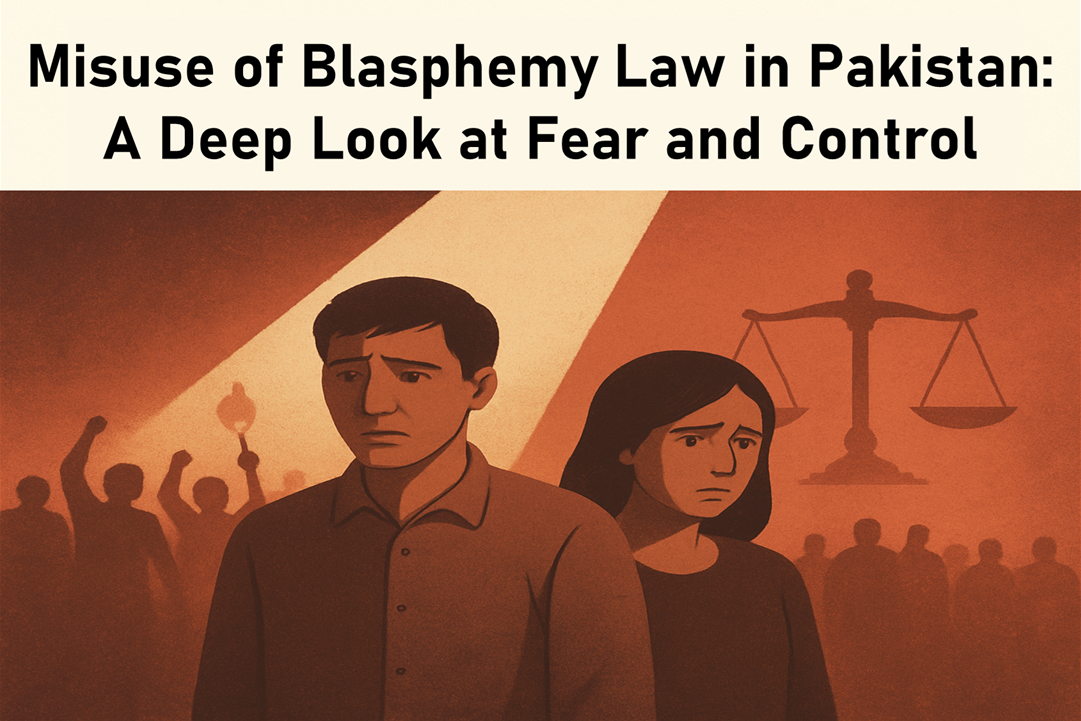
The misuse of blasphemy law in Pakistan has become one of the most troubling features of the country’s social and political landscape (HRW). Once designed to protect religious sentiments, these laws are now frequently exploited to settle personal disputes, suppress dissent and incite violence (DAWN). The fear culture in Pakistan that surrounds even the mention of blasphemy has eroded public trust, silenced dialogue and instilled a chilling effect across communities (Pakistan Today). In this deep look, we examine how a legal safeguard turned into a powerful tool of fear and control.
Misuse of Blasphemy Law in Pakistan
Section 295-C of Pakistan’s Penal Code prescribes the death penalty for derogatory remarks about the Prophet Muhammad (PBUH) (Hussain, 2013). Introduced in the 1980s, the law was meant to safeguard religious harmony (DAWN). Instead, it has become one of the most controversial statutes in the Muslim world (Chawda, 2023).
Legal experts and rights activists describe the misuse of blasphemy law in Pakistan as systematic. False accusations are often driven by personal vendettas, property disputes or political manipulation (HRW). The impact of blasphemy law on minorities in Pakistan has been especially severe with Christians, Ahmadis, and Hindus disproportionately targeted (DAWN).
According to human rights organizations, more than 1,500 people have been accused under these provisions in the past three decades—many without credible evidence (HRFW). The fear culture and speech suppression (blasphemy) phenomenon in Pakistan means journalists, lawyers, and even judges tread carefully when addressing the topic (SAMSN).
Section 295-C in Pakistan: Legal Ambiguity and Social Consequences
The Section 295-C in Pakistan reveals a disturbing pattern. In some cases, accusations emerge after petty disputes; in others, entire communities are attacked based on rumors (AP News).
The mob violence after blasphemy accusations incidents in Punjab and Khyber Pakhtunkhwa underscored the volatility of such cases. Angry crowds, often incited through social media, resorted to vigilante justice before authorities could intervene.
Legal reform remains elusive. Parliamentarians have repeatedly avoided addressing the blasphemy law reform debate in Pakistan, fearing backlash from religious hardliners (The Polis Project). The absence of judicial safeguards allows the law to remain vulnerable to abuse.
The Human Cost: Impact on Minorities and Society
The impact on minorities is devastating. Entire neighborhoods have been emptied after allegations against a single person. In many cases, accused individuals spend years in prison awaiting trial, even when evidence is flimsy or fabricated (Clooney Foundation For Justice).
Women and children are not spared. Families often flee their homes, living in secrecy to avoid retaliation. The fear culture in Pakistan has gripped society with fear and mistrust, defining the nation’s social atmosphere.
Human rights observers say this environment stifles dialogue and undermines religious intolerance and speech freedom (ICJ). Universities and think tanks seldom organize discussions on blasphemy laws, knowing the topic can provoke violence.
The Blasphemy Law Reform Debate
Despite international criticism, efforts to reform Pakistan’s blasphemy laws have faced fierce opposition. The blasphemy law reform debate continues quietly within legal circles, but open political advocacy remains limited.
Analysts argue that real reform will require not only legal amendments but also a cultural shift (Pakistan Today). The state must distinguish between protecting faith and enabling fanaticism. The blasphemy law reform debate in Pakistan has become a litmus test for whether Pakistan can balance religious conviction with constitutional freedoms.
A Society at a Crossroads
The persistence of blasphemy related violence highlights a deeper struggle within Pakistan. As long as accusations can destroy lives without due process, the fear culture and speech suppression due to blasphemy in Pakistan will endure.
In recent years, some activists and scholars have cautiously pushed for reinterpretation or procedural reform (Al Jazeera). But progress remains painfully slow.
Conclusion: The Misuse of Blasphemy Law in Pakistan and the Way Forward
The misuse of blasphemy law in Pakistan is not merely a legal flaw—it is a mirror reflecting the country’s broader crisis of intolerance, impunity and fear. From Section 295-C to countless street-level incidents, the issue intertwines law, religion and politics in a dangerous equilibrium.
Pakistan must confront the impact of its blasphemy law on minorities and stop the weaponization of religious intolerance and speech freedom, or the cycle will continue.
A meaningful national dialogue, grounded in empathy and constitutional integrity, is the only path forward. Ending the misuse of blasphemy law in Pakistan is not just about reform—it’s about reclaiming the nation’s moral and civic conscience.
FAQs
Q 1: What does Section 295-C of Pakistan’s Penal Code state?
A: Section 295-C Pakistan prescribes the death penalty or life imprisonment for anyone found guilty of using derogatory remarks about the Prophet Muhammad (PBUH). Introduced during the 1980s, this law has become highly controversial due to its alleged misuse and lack of procedural safeguards. Legal experts argue that clearer definitions and reforms are essential to prevent false accusations and violence.
Q 2: How is the misuse of blasphemy law in Pakistan affecting minorities?
A: The misuse of blasphemy law in Pakistan has had a profound impact on minorities. Human right groups reports that authorities have accused many Christians, Ahmadis and Hindus on the basis of weak or fabricated evidence, resulting in their imprisonment, displacement or exposure to mob violence. Human Right groups say that this trend contributes to a broader fear culture in Pakistan, discouraging open discussion about religion and justice.
Q 3: Why is there resistance to blasphemy law reform in Pakistan?
A: Efforts to address the blasphemy law reform debate in Pakistan face strong opposition from religious and political groups. Many lawmakers avoid discussing reforms due to fear of backlash or accusations of blasphemy themselves. This resistance has stalled legislative change, leaving religious intolerance and speech freedom in a delicate balance.
Q 4: What steps can Pakistan take to prevent further misuse of blasphemy laws?
A: To curb the misuse of blasphemy law in Pakistan, experts recommend judicial oversight, penalties for false accusers and clearer evidentiary standards. Promoting education and tolerance can also help dismantle the fear culture and speech suppression due to blasphemy in Pakistan dynamic. Ultimately, reform must combine legal measures with a broader cultural shift toward justice and accountability.
Share Your Thoughts
The misuse of blasphemy law in Pakistan continues to raise difficult questions about justice, fear and faith in our society. What’s your perspective on how these laws shape our national discourse and affect ordinary citizens?
Share your thoughts in the comments below — your voice matters in breaking the silence around this critical issue.
Additional Material
To further understand the complexities surrounding Pakistan’s blasphemy laws, here are two insightful reports.
