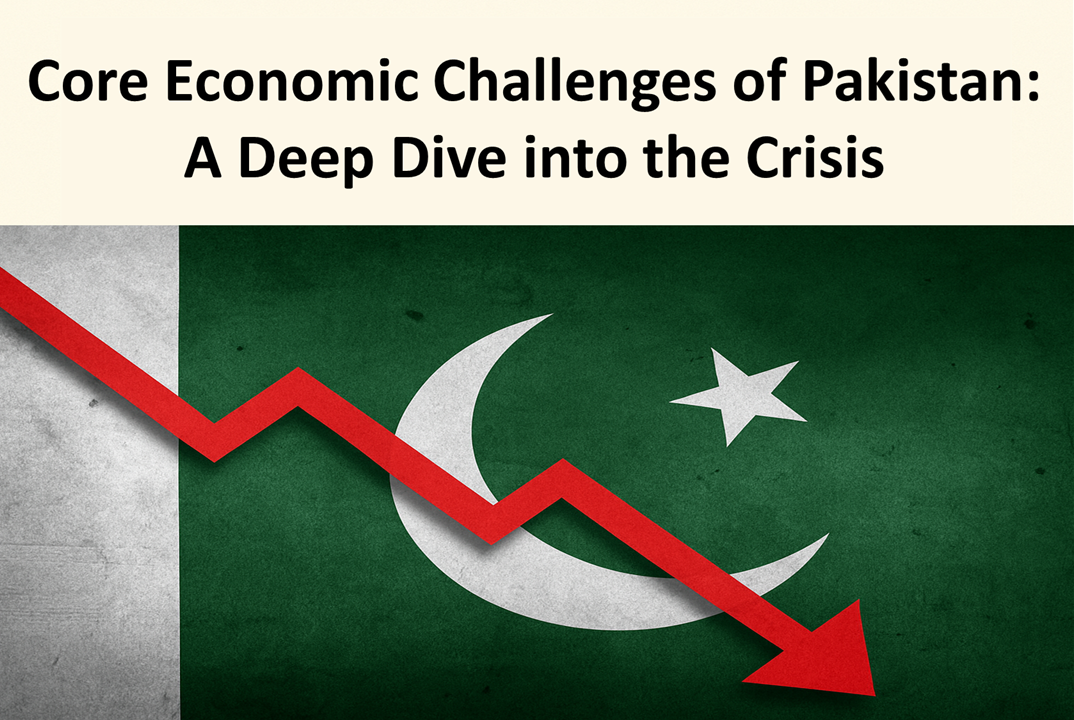
Pakistan’s economy stands at a critical crossroads, facing deep structural weaknesses that have compounded over decades (WorldBankGroup). The core economic challenges of Pakistan are not just about low income or debt; they stem from systemic issues of productivity, governance, inequality and political instability. To understand why growth remains elusive, one must look beyond surface indicators and examine the fundamental cracks in the system.
This article aims to explore why the country continues to underperform despite its potential and what steps are needed to steer it toward sustainable recovery.
Why Pakistan’s Poverty is Different
Unlike other developing nations, Pakistan’s poverty is marked by anomalies. For instance, child mortality rates remain disproportionately high even after adjusting for per capita income. Every year, more than 300,000 children under the age of five die unnecessarily (WHO), a number far higher than comparable countries.
This points to deep inefficiencies in governance and service delivery, making Pakistan’s poverty unique and more damaging.
How Political Instability Fuels Economic Crisis
A recurring theme in Pakistan’s economic story is political instability. Successive governments have failed to establish continuity in policy, often abandoning reforms midway. Short-term populist measures—such as subsidies or artificially fixed exchange rates—have replaced structural reforms.
The decision-making process is described as “broken,” with political parties prioritizing electoral gains over sound economic management (DAWN). This lack of institutional maturity perpetuates economic crises and fuels public disillusionment.
Why Pakistan Keeps Returning to the IMF
One of the most pressing core economic challenges of Pakistan is its recurring dependence on the International Monetary Fund (IMF). While the IMF is meant to provide temporary liquidity support, Pakistan has turned to it repeatedly, treating it as a long-term solution.
This reliance stems from chronic balance of payment issues, driven by a failure to boost domestic productivity and exports. Instead of investing in industries that generate sustainable income, Pakistan has relied heavily on imports, remittances, and borrowing—creating an unsustainable cycle of debt.
Weak Industrial Policy and Stagnant Productivity
Pakistan’s economic growth has consistently fallen behind its global competitors due to stagnant productivity (DAWN). The lack of a coherent industrial policy has left the country dependent on traditional sectors such as textiles, with little diversification (TheNews).
Experts argue that Pakistan must prioritize specific industries, such as renewable energy and agriculture technology, to build competitive advantage (Reuters). Without sectoral focus and an export-driven strategy, productivity will remain stagnant and growth potential untapped.
Energy Dependence and Balance of Payments Issues
Pakistan’s energy mix, heavily dependent on imported fossil fuels, lies at the heart of its economic instability (INP). Rising global oil prices have consistently triggered balance of payment crises, forcing Pakistan to seek external bailouts (Anam and Eatzaz, 2024).
Shifting towards renewables and battery technology is seen as a critical step not only to secure affordable energy but also to stabilize external accounts (WorldEconomicForum). Investing in domestic energy capacity could help reduce import dependence while creating new export opportunities.
The Remittance Illusion
While remittances are often celebrated as a lifeline for the economy, they mask deeper weaknesses. For every dollar of exports, Pakistan receives nearly a dollar in remittances, a ratio far higher than India or Bangladesh.
| Country | Year / Fiscal Period | Exports (Goods + Services) USD | Remittances USD | Remittances : Exports Ratio (approx) |
| Pakistan | FY 2023-24 | $30.645 bn exports (Business Recorder) | $30.3 bn remittances (Business Recorder) | ~ 0.99 |
| Pakistan | FY 2024-25 | $16.561 bn exports (Business Recorder) | $17.645 bn remittances (Business Recorder) | ~ 1.07 |
| India | FY 2023-24 | $778 bn exports (DD News) | ~ $125-135 bn remittances (2024) (ndtv) | ~ 0.16-0.18 |
| Bangladesh | FY 2024-25 | Target for exports (goods, projected) $50 bn; $44.5-46.6 bn recent baseline (Business Recorder) | ~ $30 bn remittances in FY25 (Bangladesh)(The Daily Star) | ~ 0.65 (if comparing remittances relative to exports of that level) |
This reflects weak domestic productivity and limited export capacity. In effect, Pakistan is financing its consumption through overseas workers rather than homegrown production—a model that is neither sustainable nor scalable.
Low Investment and an Unproductive Elite
Another core economic challenge of Pakistan is its low investment rate, worsened by speculative trends. A significant share of wealth is funneled into unproductive assets such as real estate and land speculation, rather than businesses that generate jobs and exports.
Introducing reforms like land taxation and redirecting resources toward infrastructure and industry could help channel investments into productive sectors, but political resistance from powerful elites has slowed progress (DAWN).
Key Reforms Needed to Overcome Core Economic Challenges of Pakistan
Experts agree that solving Pakistan’s economic crisis requires long-term structural reforms rather than cosmetic fixes (WorldBankGroup). Key priorities include:
1. Fixing the Balance of Payments – Designing policies to ensure modest current account surpluses and reduce reliance on IMF bailouts.
2. Energy Independence – Shifting towards renewables to reduce import dependence.
3. Tax Reforms – Expanding the tax base, implementing land and inheritance taxes, and reducing amnesty schemes.
4. Boosting Exports – Developing industrial policy around priority sectors such as energy technology and agriculture.
5. Institutional Maturity – Political parties must rise above short-term populism to build consistent, evidence-based policies.
Conclusion
The core economic challenges of Pakistan are deeply entrenched, spanning political, structural and social dimensions. From poor productivity and energy dependence to political instability and reliance on remittances, the country faces a daunting path ahead. Yet, the solutions are clear: invest in productivity, reform governance and prioritize sustainable growth sectors.
With the right mix of vision, policy discipline and political will, Pakistan can move beyond its chronic crises and unlock the economic potential its people deserve.
FAQs
Q1: Why is Pakistan’s economy in crisis?
A: Pakistan’s economy struggles due to structural weaknesses such as low productivity, overreliance on imports, political instability, and weak governance. These factors create recurring fiscal and external deficits, pushing the country toward repeated bailouts.
Q2: Why does Pakistan keep turning to the IMF?
A: Because of chronic balance of payments issues. Pakistan imports more than it exports and relies heavily on remittances and borrowing. When foreign reserves run out, the IMF becomes the lender of last resort.
Q3: How is Pakistan’s poverty different from other developing nations?
A: Even at similar income levels, Pakistan has worse social indicators. Child mortality remains high, literacy lags behind neighbors, and public services are inefficient — showing that poverty is not just financial but systemic.
Q4: What role does political instability play in the economic crisis?
A: Frequent government changes and short-term populist measures undermine consistent policy. Reforms are often abandoned midway, preventing long-term progress and damaging investor confidence.
Q5: Why are remittances both a strength and a weakness?
A: Remittances provide vital foreign exchange, often matching export earnings. However, they mask weak domestic productivity and make the economy dependent on overseas workers rather than homegrown industries.
Q6: How do speculative investments hurt Pakistan’s economy?
A: A large share of wealth goes into real estate and land speculation instead of industries that create jobs and exports. This diverts capital away from productive sectors, slowing growth.
Share Your Thoughts
Pakistan’s economic crisis is shaped by politics, governance, and deep structural challenges — but solutions are on the table. Do you believe bold reforms are possible, or will short-term fixes continue to hold the country back? Share your thoughts in the comments below — your perspective could add a fresh angle to this debate.
