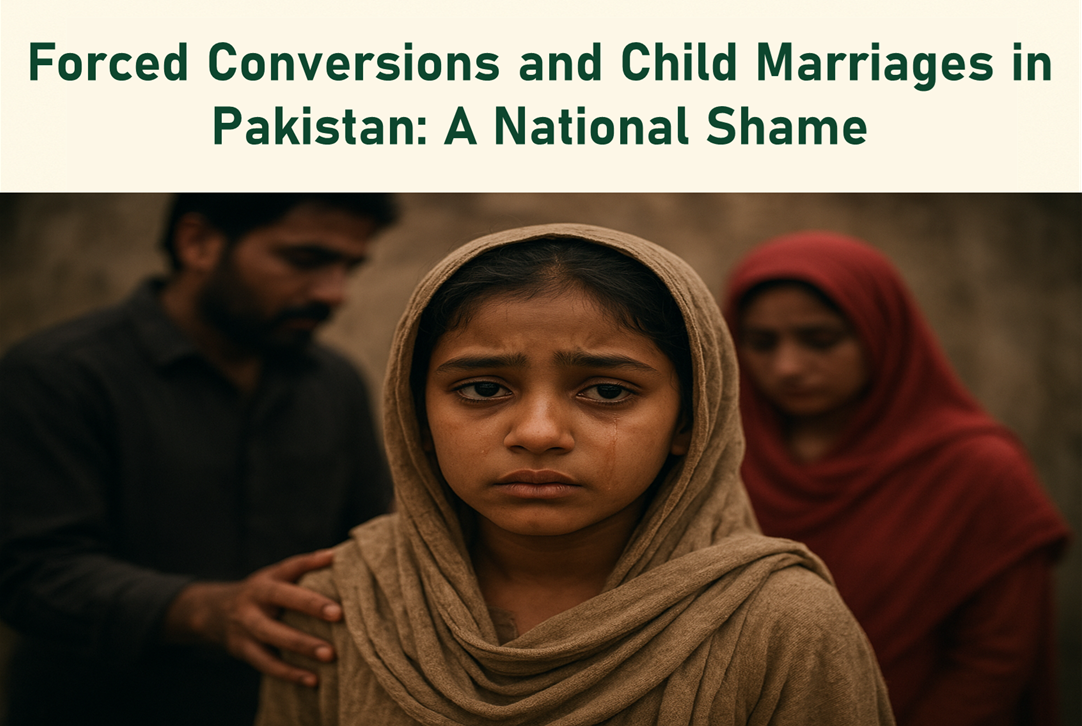
Across Pakistan, the recurring stories of underage girls being abducted, forcibly converted and married off expose one of the country’s deepest social wounds (DAWN). Despite public outrage and promises of reform, forced conversions and child marriages in Pakistan remain rampant (Tribune). A national shame that continues to erode the rights of women and minorities.
The Legal Framework: Laws That Fail the Vulnerable
Pakistan’s legal architecture appears robust on paper. The Child Marriage Restraint Act of 1929 set the minimum marriage age at 18 for males and 16 for females. However, Sindh has since amended it and declared the minimum age of 18 for both. Sindh even strengthened it through the Sindh Child Marriage Restraint Act (2013), the only province to criminalize marriages below that age without exceptions (UNFPA).
Yet, implementation tells a different story. In Punjab and Khyber Pakhtunkhwa, the age of marriage for girls remains 16. The Prohibition of Forced Conversion Bill, drafted multiple times since 2016, has repeatedly stalled in parliament due to political and religious opposition (DAWN).
Legal loopholes allow perpetrators to manipulate documentation, forging birth certificates or coercing minors to testify that they converted “willingly” (Herald). Consequently, law enforcement rarely intervenes and courts often side with the abductor’s narrative (The Guardian).
A Disturbing Pattern: Numbers Behind the Crisis
Although exact figures are difficult to verify, human rights organizations report a large number of cases of forced conversions in Pakistan (APPG). Reports from organizations such as the Centre for Social Justice and Voice for Justice show that the majority of victims are Hindu and Christian girls, typically between 12 and 16 years old (CSJPAK).
In Sindh, where most cases are reported, local clerics and marriage registrars often conduct such unions without verifying age or consent (UNFPA). Media investigations reveal that nearly 20-30% of women in rural Sindh and Balochistan were married before 18, a staggering figure that reflects deep-rooted gender and economic inequality.
Why Forced Conversions and Child Marriages Persist
A toxic mix of poverty, patriarchy, and religious intolerance drives the persistence of forced conversions and child marriages in Pakistan.
Families in impoverished communities often view early marriage as an escape from economic burden or social stigma (UNICEF). In minority populations, abductions followed by coerced conversions are often justified as “religious acts”, creating a climate of impunity (Al Jazeera).
Cultural customs such as Vani and Swara — where girls are given in marriage to settle tribal disputes — further normalize the exploitation of minors. Weak education systems and lack of birth registration make it easier for offenders to manipulate a victim’s age and legal status.
Victims’ Stories and Legal Gaps
Behind every statistic lies a silenced story. Cases like Dua Zehra and Saba Nadeem made national headlines, revealing how flawed documentation and coercive tactics let perpetrators evade justice. Many victims never reunite with their families.
Legal experts argue that Pakistan’s judiciary often prioritizes “consent” over age verification, even when girls are clearly minors (The News). Without strict birth record systems or witness protection, families face immense pressure to withdraw complaints.
The Human Cost: A Lifetime of Trauma
Early marriage and conversion are not just legal issues — they leave lasting scars. Victims face physical abuse, psychological trauma and the complete loss of education and personal agency. Child brides are at high risk of maternal mortality, domestic violence and chronic poverty (IHSN).
Human rights observers classify these practices as modern slavery — a systematic denial of freedom disguised under religion and culture.
Advocacy, Resistance and the Road Ahead
Despite the bleak reality, there are signs of hope. Civil society groups such as Aurat Foundation, Centre for Social Justice and Human Rights Commission of Pakistan continue to campaign for stronger legislation and awareness. Religious scholars from progressive circles have also condemned forced conversions as un-Islamic, emphasizing that faith cannot be imposed (The Tribune).
Advocates are calling for:
- A uniform national minimum marriage age of 18
- Criminalization of forced conversions with strict penalties
- Mandatory birth registration and age verification
- Protection centers for victims and families under threat
Public awareness campaigns and media coverage have begun to challenge silence — but real change demands political courage and societal empathy.
Conclusion: Ending the National Shame
Forced conversions and child marriages in Pakistan do not occur in isolation — they expose a systemic failure of justice, compassion, and equality. Each unpunished case undermines the nation’s constitutional promise of religious freedom and women’s protection.
Until Pakistan enforces its laws and safeguards its most vulnerable citizens, these crimes will remain an open wound on the country’s conscience — a national shame that demands urgent redress.
FAQs
Q 1. How common are forced conversions and child marriages in Pakistan?
A. Exact figures are hard to verify, but human rights organizations report a large number of cases of forced conversions in Pakistan, mostly involving Hindu and Christian girls between 12 and 16 years old. Child marriage, however, is far more widespread — surveys suggest that nearly 20-30% of girls in rural areas are married before 18.
Q 2. What laws exist to prevent forced conversions and child marriages in Pakistan?
A. Pakistan has the Child Marriage Restraint Act (1929), which sets minimum marriage ages — though enforcement varies by province. Sindh’s law sets 18 as the legal age for marriage (male and female), while Punjab and Khyber Pakhtunkhwa still allow marriage at 16 (for female). Lawmakers have proposed several drafts of the Prohibition of Forced Conversion Bill, but political and religious resistance has prevented their passage.
Q 3. Why do forced conversions and child marriages persist despite existing laws?
A. Weak law enforcement, forged age documents, poverty and social acceptance of patriarchal norms enable these practices to continue. Courts often accept coerced statements of “consent” from minors, while police face pressure not to pursue cases involving religious sensitivities or powerful local figures.
Q 4. What can be done to stop forced conversions and child marriages in Pakistan?
A. Experts and activists recommend a uniform national marriage age of 18, criminalization of forced conversions, stronger birth registration systems and legal protection for victims. Public awareness campaigns, community engagement and better enforcement of existing laws are essential to ending this crisis.
Share Your Thoughts
Forced conversions and child marriages continue to silence countless young voices in Pakistan — but your voice matters.
Share your thoughts, questions, or personal experiences in the comments below. Let’s start the conversation that leads to change.
Additional Material
To further understand the issue of forced conversions and child marriages, here are two insightful reports.
