Pakistan’s youth economy could become its biggest untapped resource, if managed with the right mix of policy vision, investment and innovation (DAWN).
With nearly 64% of its population under the age of 30, the country is home to one of the youngest populations in the world. This so-called “youth bulge” has been framed both as a blessing and a ticking time bomb (Tribune). On one hand, it represents an unprecedented pool of human capital. A potential engine for innovation, productivity and economic growth. On the other, it raises questions about how to provide jobs, skills and opportunities to millions entering the labor force each year.
The Employment Challenge
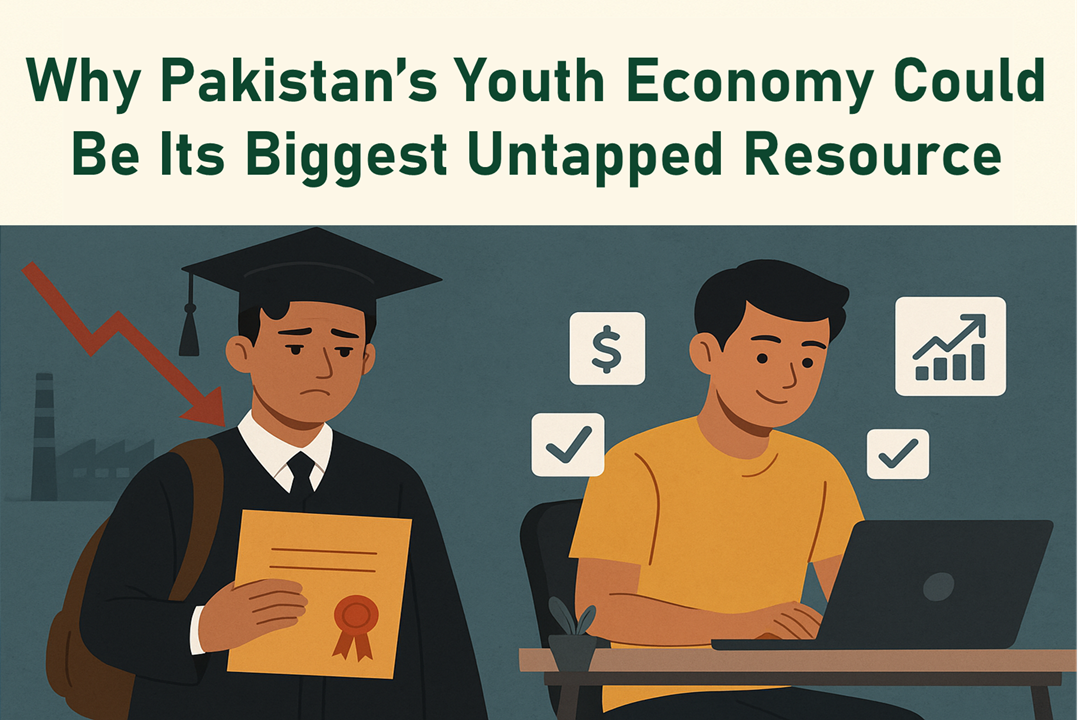
Youth unemployment stands at over 11.1 %, with millions more underemployed or working in the informal sector. Each year, approximately two million young Pakistanis enter the job market (DAWN) but the economy fails to absorb even half that number (The News).
This employment gap has deep structural roots. Many graduates emerge with degrees but lack the technical or soft skills employers demand (Pro Pakistani).
Without strategic intervention, this mismatch between education and employment could widen, threatening social stability and economic resilience.
Digital Transformation: A Pathway to Inclusion
Amid this challenge lies opportunity. The digital economy is emerging as a powerful equalizer, offering new ways to engage young talent beyond traditional employment (World Bank Group). Pakistan’s freelance and startup sectors are expanding rapidly which is powered by affordable internet, growing fintech infrastructure and global demand for remote services.
Pakistan is already ranked among the top five countries for freelance IT services. Young freelancers are earning millions of dollars collectively, often working for international clients. Platforms like Upwork, Fiverr and LinkedIn have become virtual workplaces for a generation that refuses to wait for jobs to come to them.
Entrepreneurship as a Solution to Unemployment
As traditional job creation lags, entrepreneurship is becoming a critical unemployment solution (Asad, 2014). From agritech startups in Punjab to renewable energy ventures in Sindh, young Pakistanis are demonstrating resilience and creativity in solving local problems.
However, the ecosystem remains fragile. Limited access to finance, regulatory bottlenecks and risk-averse investment culture often stifle early-stage innovation (Business Recorder).
Policymakers and private investors must collaborate to nurture a startup-friendly environment, streamline business registration and expand microcredit and venture funding.
Public-private partnerships can also play a vital role — linking academia, industry and youth incubators to bridge skill gaps and foster job creation.
Education Reform: The Missing Link in Pakistan’s Youth Economy
A skills-first education model is crucial for sustaining youth-led growth. Experts advocate reforms that integrate technical and vocational training (TVET), digital literacy and entrepreneurship into mainstream education (Planipolis).
Countries like Malaysia and Vietnam have successfully transitioned their youth bulges into productive labor forces by aligning education with industry demand.
Pakistan can follow suit by modernizing curricula, incentivizing private-sector apprenticeships, and investing in teacher training.
The Policy Imperative to Drive Pakistan’s Youth Economy
Unlocking Pakistan’s youth economy requires more than slogans. It demands coordinated policy frameworks that prioritize:
- Youth employment and entrepreneurship programs with measurable impact.
- Digital infrastructure to support remote work and e-commerce.
- Access to finance through youth-led venture funds and credit schemes.
- Inclusive governance, giving young people a voice in policymaking.
With the right strategy, the youth bulge can transform from a liability into an advantage, turning Pakistan into a hub for digital services, innovation and small enterprise growth.
Conclusion: A Generational Opportunity
The stakes are high, but so is the potential. Pakistan’s youth economy represents more than demographics; it’s a generational opportunity to redefine development. If empowered with education, technology and entrepreneurship, young Pakistanis could become the driving force of the country’s next economic boom.
The question is not whether Pakistan can afford to invest in its youth but whether it can afford not to.
FAQs
Q1: What is meant by Pakistan’s youth economy?
A: Pakistan’s youth economy refers to the economic potential of its young population. Individuals under 30 who make up nearly 64% of the country’s population. If empowered through education, digital skills and entrepreneurship opportunities, this demographic could drive national growth, innovation and productivity.
Q2: Why is youth unemployment such a critical issue in Pakistan?
A: Youth unemployment in Pakistan stands at over 11.1 %, with millions more underemployed or working informally. Each year, around two million young people enter the job market, but the economy cannot absorb even half of them. This mismatch between education and industry demand is a key reason why job creation lags behind population growth.
Q3: What are the best solutions to Pakistan’s youth unemployment problem?
A: Pakistan must adopt a multi-pronged approach:
- Reform education to focus on technical, digital and entrepreneurial skills.
- Expand access to microcredit and venture capital for startups.
- Encourage public–private partnerships to connect academia, industry and youth incubators.
- Promote the digital and freelance economy to create flexible and remote opportunities for young professionals.
Share Your Thoughts
Can Pakistan turn its youth bulge into a competitive advantage — or is it missing the moment?
Share your thoughts, insights, or stories from your community in the comments below. Your perspective could spark the next big idea.
