
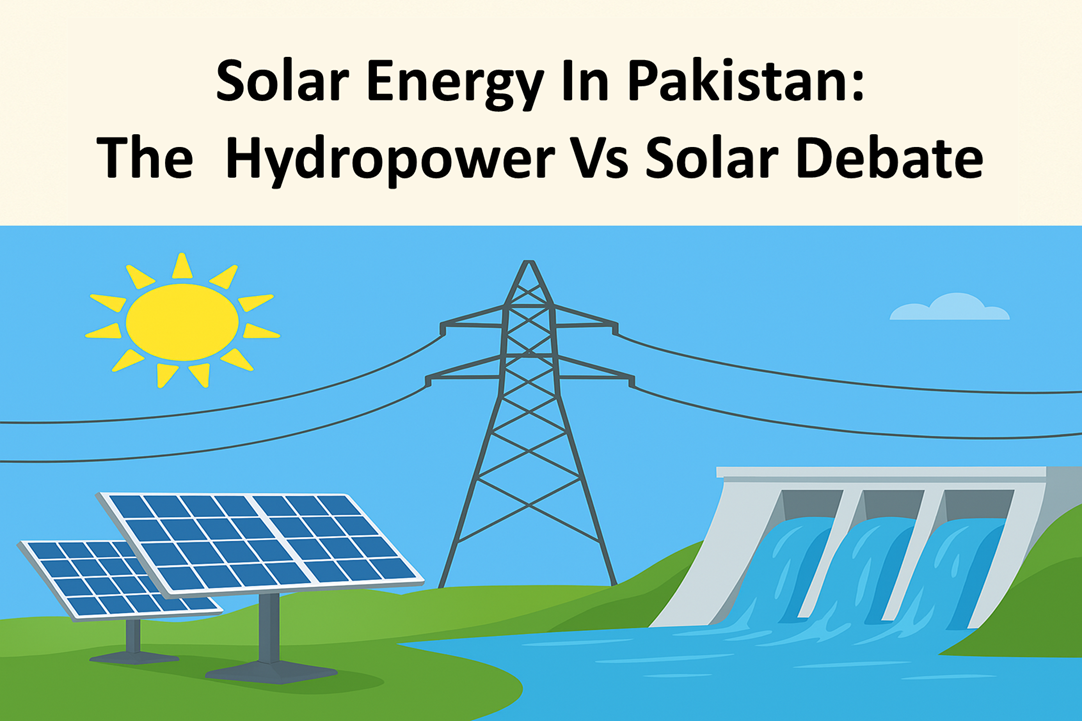
Pakistan’s energy dilemma continues to shape its economic destiny. As demand surges and fossil fuel dependence deepens, renewable energy has become an urgent national priority (The News). Solar energy in Pakistan has seen a recent boom among the local population (Reuters). But in the hydropower vs solar debate, Pakistan still looks to be divided over which path offers a more sustainable and secure future?
Hydropower in Pakistan: Strengths and Setbacks
Hydropower has long been the backbone of Pakistan’s renewable energy portfolio, contributing roughly 25–30% of total generation through major projects like Tarbela, Mangla, and Neelum–Jhelum dams (The News).
Advantages of Hydropower
- Provides stable baseload power for national grid reliability.
- Delivers low operational costs after initial construction.
- Supports energy storage potential through pumped-hydro systems.
Challenges Facing Hydropower
Despite its proven reliability, hydropower development in Pakistan faces growing limitations:
- Long construction timelines and high capital costs.
- Environmental concerns, including deforestation and ecosystem disruption.
- Climate vulnerability—melting glaciers and erratic rainfall reduce water availability.
With these factors, many experts argue that while hydropower remains essential, it’s no longer the sole solution for Pakistan’s clean energy transition.
Solar Energy in Pakistan: A Rapidly Rising Power
Few countries enjoy solar potential like Pakistan. With over 300 sunny days a year, solar power offers a scalable and low-cost solution to the country’s chronic energy shortages.
Government Initiatives and Private Investment
The Alternative and Renewable Energy (ARE) Policy 2019 set ambitious goals to increase renewables to 30% of the energy mix by 2030. Major developments include:
- Quaid-e-Azam Solar Park (Bahawalpur), one of South Asia’s largest solar farms.
- CPEC solar projects, driving infrastructure and technology transfer.
- Expanding rooftop solar and net metering programs empowering households and industries.
Why Solar is Gaining Momentum
- Lower cost per kWh than imported fossil fuels.
- Quick installation and modular scalability.
- Decentralized power generation enabling off-grid rural electrification.
Still, solar faces barriers such as high upfront costs for small consumers and limited energy storage infrastructure.
Hydropower vs Solar: Comparing Costs and Scalability
Cost Efficiency
According to experts:
- Solar: USD 0.03–0.04 per kWh
- Hydropower: USD 0.08–0.10 per kWh
Solar’s rapid cost decline makes it more attractive for private investors and industrial energy independence.
Scalability and Implementation Speed
- Hydropower: Large-scale, long-term and centralized.
- Solar: Fast-deploying, flexible and adaptable to both grid and off-grid systems.
For a country like Pakistan—where demand is rising faster than generation capacity—solar’s speed and scalability provide a significant strategic advantage.
Environmental and Social Impact
Hydropower:
- Risk of community displacement and ecosystem disruption (The News).
- Increasingly sensitive to climate variability (World Bank Group).
Solar:
- Requires land but causes minimal ecological disruption.
- Offers opportunities for rooftop integration and brownfield utilization (Talut et al., 2022).
From a sustainability perspective, solar energy in Pakistan offers a more climate-resilient option, particularly given the country’s exposure to extreme weather and water scarcity.
Hybrid Solutions: The Smart Energy Future
Rather than choosing one source over the other, Pakistan’s optimal path may be a hybrid renewable energy system combining both solar and hydropower.
How Hybrid Systems Work
- Solar produces during the day.
- Hydropower provides night-time and peak-hour supply.
- Excess solar energy can be stored in pumped-storage hydropower systems.
This synergy enhances grid reliability, reduces blackouts and maximizes renewable utilization—a model already proven successful in several countries like China, Greece etc.
Policy and Investment Outlook
To unlock Pakistan’s full renewable potential, policymakers should:
- Simplify licensing and net metering procedures.
- Offer tax incentives for clean energy equipment.
- Strengthen public-private partnerships for large-scale solar deployment.
- Prioritize climate resilience in hydropower design.
Investors should watch for expanding solar industrial zones, microgrid initiatives and energy storage projects, which signal Pakistan’s next growth frontier in renewable energy.
Conclusion: A Balanced Energy Strategy for Pakistan
In the hydropower vs solar debate, Pakistan’s future lies in balance, not competition.
- Short-term priority: Scale solar for quick capacity expansion.
- Long-term necessity: Modernize hydropower for reliability and storage.
Together, these sources can create a clean, affordable, and resilient energy mix—driving sustainable development and energy security for decades to come.
FAQs
Q1. Which renewable energy source is more cost-effective for Pakistan — solar or hydropower?
A: According to NEPRA and World Bank data, solar power in Pakistan costs between USD 0.03–0.05 per kWh, while hydropower averages USD 0.04–0.08 per kWh, depending on project size and financing. Solar’s rapid price decline and shorter construction timelines make it more cost-competitive for new generation capacity, though hydropower remains valuable as a stable baseload source for grid reliability.
Q2. Why is solar energy gaining momentum in Pakistan?
A: Pakistan receives over 300 sunny days per year, offering ideal conditions for solar generation. Falling solar panel prices, net metering incentives, and growing demand for energy independence have driven adoption across homes, businesses, and industries. Solar projects are faster to deploy, modular, and well-suited for rural electrification, making them a practical path to expand access while reducing reliance on imported fossil fuels.
Q3. What are the main challenges of relying on hydropower in Pakistan?
A: Hydropower development in Pakistan faces long construction timelines, high capital costs, and environmental challenges such as community displacement and river ecosystem disruption. It’s also increasingly vulnerable to climate change, as melting glaciers and erratic rainfall affect water availability and generation capacity. These risks highlight the need to diversify with faster, climate-resilient renewable options like solar and wind.
Share Your Thoughts
Pakistan stands at a crossroads — should the future shine under solar panels or flow through hydropower dams?
What’s your take on where Pakistan’s energy investments should go next? Share your thoughts below — your perspective could spark the policy conversation we need.
