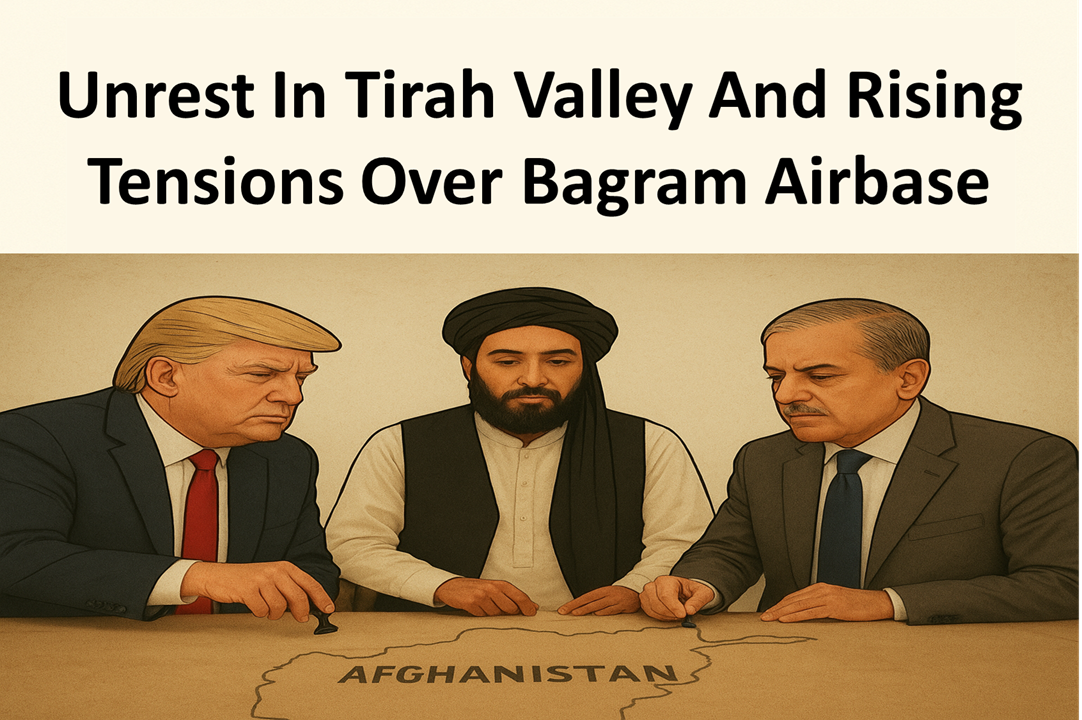
The current unrest in Tirah valley combined with the rising tensions over Bagram Airbase has global implications. It reflects the fragile security environment along Pakistan’s tribal belt.
Former U.S. President Donald Trump’s demand to “reclaim” Bagram Airbase has reignited geopolitical debates (Al-Jazeera). While in Pakistan’s Tirah Valley, explosions and civilian casualties have sparked protests and anger (DAWN).
Both issues, though seemingly separate, converge on one point:
“Pakistan will find itself caught in the middle of intensifying regional power struggles.”
Understanding these developments is crucial for anticipating the security, political and diplomatic challenges that will be faced by Islamabad.
Trump’s Renewed Threats Over Bagram Airbase
Former U.S. President Donald Trump has once again thrust Afghanistan into the global spotlight. In his recent address, Trump criticized the Biden administration for what he called a “historic blunder”, handing back Bagram Airbase in 2021 (The-Gaurdian). The airbase, located just 60 km from Kabul and near the Wakhan Corridor, is considered one of the most strategic military sites in Asia.
Trump warned that if Afghanistan does not “return” Bagram to the United States, “bad things” could happen. The language was blunt, almost schoolboy-like, but the implications are serious. Washington views the airbase as vital for monitoring both Islamic State–Khorasan (ISIS-K) activities in Afghanistan and China’s nearby nuclear assets in Xinjiang.
For Trump, regaining a foothold at Bagram is about more than Afghanistan. It’s about countering China, checking Iran, and maintaining American presence in a shifting world order.
Why Bagram Matters Strategically
The Bagram Airbase carries historical and strategic weight. Built in the 1950s by the Soviets, it was later expanded by the U.S. military after 2001 (The-Gaurdian). It became notorious for hosting detainees and torture, but also operated as America’s most critical hub for air operations in the region.
From Bagram, U.S. forces could monitor China’s Lop Nur nuclear site and the PLA Rocket Force facilities in Xinjiang. Its proximity to Iran also made it invaluable for surveillance.
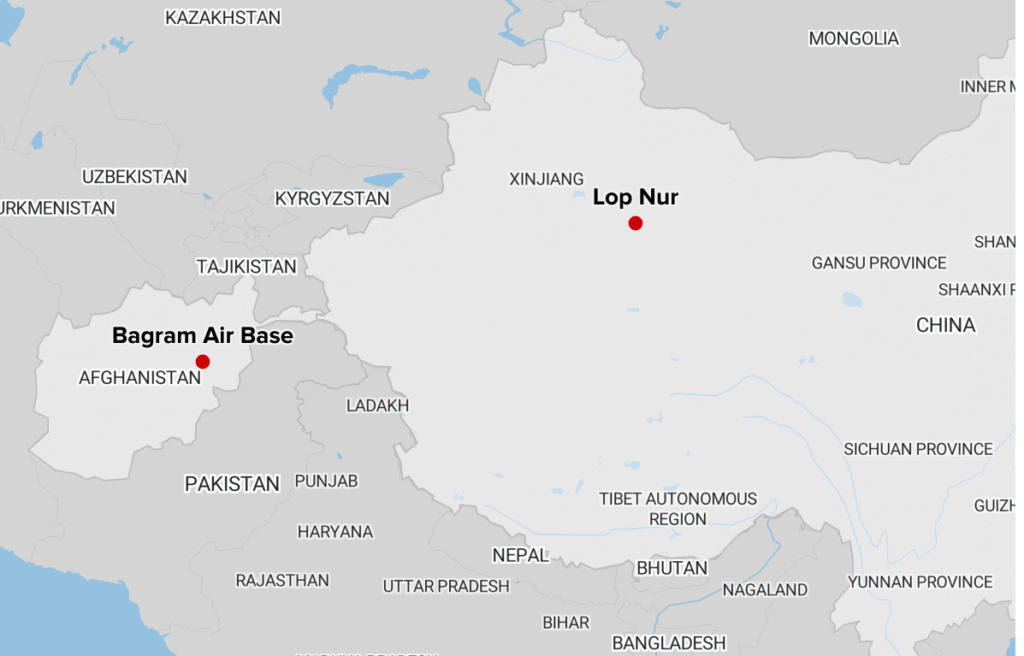
For Washington, losing the base created a “blind spot” in Central Asia — one Trump now wants to correct.
However, the Taliban leadership has rejected the idea outright, publicly vowing not to give “an inch” of Afghan land back to the U.S. Behind closed doors, though, negotiations may be underway.
Frozen Afghan assets worth $9–10 billion, potential recognition of the Taliban government and mineral deals could form part of a compromise package.
Pakistan’s Dilemma Over Bagram
For Islamabad, the possibility of a U.S. return to Bagram is deeply sensitive. Publicly supporting it would enrage hardliners and nationalists, who would accuse Pakistan of backing Western encroachment in the region. Open opposition, however, risks alienating Washington at a time when U.S.–Pakistan ties are already fragile.
Meanwhile, China — Pakistan’s closest strategic ally — would see any renewed U.S. presence on its border as a direct threat. That places Islamabad in a precarious position. Whichever way it leans, one of its powerful partners will be displeased.
The likely outcome is Pakistan adopting a dual approach: public opposition paired with quiet cooperation.
This has been Islamabad’s balancing act in the past and it may be the only realistic option now. But such maneuvering will test Pakistan’s diplomatic skills like never before.
Unrest in Tirah Valley: Civilian Losses Spark Outrage
While Afghanistan debates the fate of Bagram, Pakistan’s Tirah Valley has witnessed another tragedy. On Friday, powerful explosions ripped through the area, killing at least 25 people, including 10 civilians.
Official sources claim the blasts occurred at a Taliban compound where explosives were being prepared. Locals, however, insist entire families were wiped out, sparking protests and a sit-in by grieving residents. Footage of funerals and demonstrations has circulated widely, amplifying anger.
The provincial government has announced financial compensation for victims’ families but locals demand something far more significant.
“Locals in Tirah Valley demand written guarantees that such incidents will not happen again.”
The Human Cost in Pakistan’s Tribal Belt
The unrest in Tirah valley underscores a grim reality for people living in Khyber Pakhtunkhwa’s conflict-hit areas. Unlike urban Pakistanis preoccupied with jobs, education or housing, residents here live with daily fears.
Whether they’ll return alive after leaving home, whether their children will avoid landmines and whether violence will once again engulf their villages.
For decades, the Pashtun Belt has been the battleground between militants and the state. Civilians remain trapped in the crossfire. While Islamabad argues it must confront the Pakistani Taliban militarily, the collateral damage continues to erode trust.
Unless the voices of local communities are heard, resentment will only deepen. A scenario militant groups could exploit.
What Both Crises Mean for Pakistan
Both the Bagram debate and the unrest in Tirah valley reflect Pakistan’s central dilemma. How to balance security imperatives with political realities at home and abroad.
Internationally, Pakistan must walk a tightrope between the U.S. and China if Bagram returns to the headlines.
Domestically, it must address the grievances of its tribal citizens to prevent further alienation.
Failing on either front risks destabilizing the country at a time when its economic and political challenges are already mounting.
Conclusion
As the U.S. debates a return to Bagram and explosions rock Tirah valley, Pakistan finds itself at the heart of two unfolding crises. The geopolitical chessboard and the human cost of conflict, both demand careful attention. Islamabad’s decisions in the coming months will shape not just its foreign relations but also the stability of its own borders.
Silence and delay will only worsen the situation. Pakistan must navigate these storms with clarity, empathy and strategic foresight or risk being swept away by forces beyond its control.
FAQs
Q1: Why is Bagram Airbase so important for the U.S. and its rivals?
A: Because of its proximity to China, Iran, and Central Asia, Bagram allows military surveillance and quick-strike capability, making it one of the most strategic sites in Asia.
Q2: How does the unrest in Tirah Valley affect Pakistan’s internal security?
A: Civilian casualties fuel resentment, weaken trust in the state, and create openings for militant groups to exploit local anger.
Q3: What choices does Pakistan face regarding a possible U.S. return to Bagram?
A: Pakistan must carefully balance ties with the U.S. while managing its alliance with China, avoiding alienating either power.
Q4: What steps can Pakistan take to address the grievances of people in tribal areas?
A: Ensuring accountability, providing compensation, improving local governance, and including communities in decision-making can help rebuild trust.
Share Your Thoughts
Do you think Pakistan can balance the growing U.S.–China rivalry while addressing unrest at home? Share your thoughts in the comments — your perspective matters in this debate.
Additional Material
For further insight into the topic, we recommend the following videos:
